At the Mer de Glace, a changing mountain landscape
New photographs document the shrinking glacier above Chamonix.
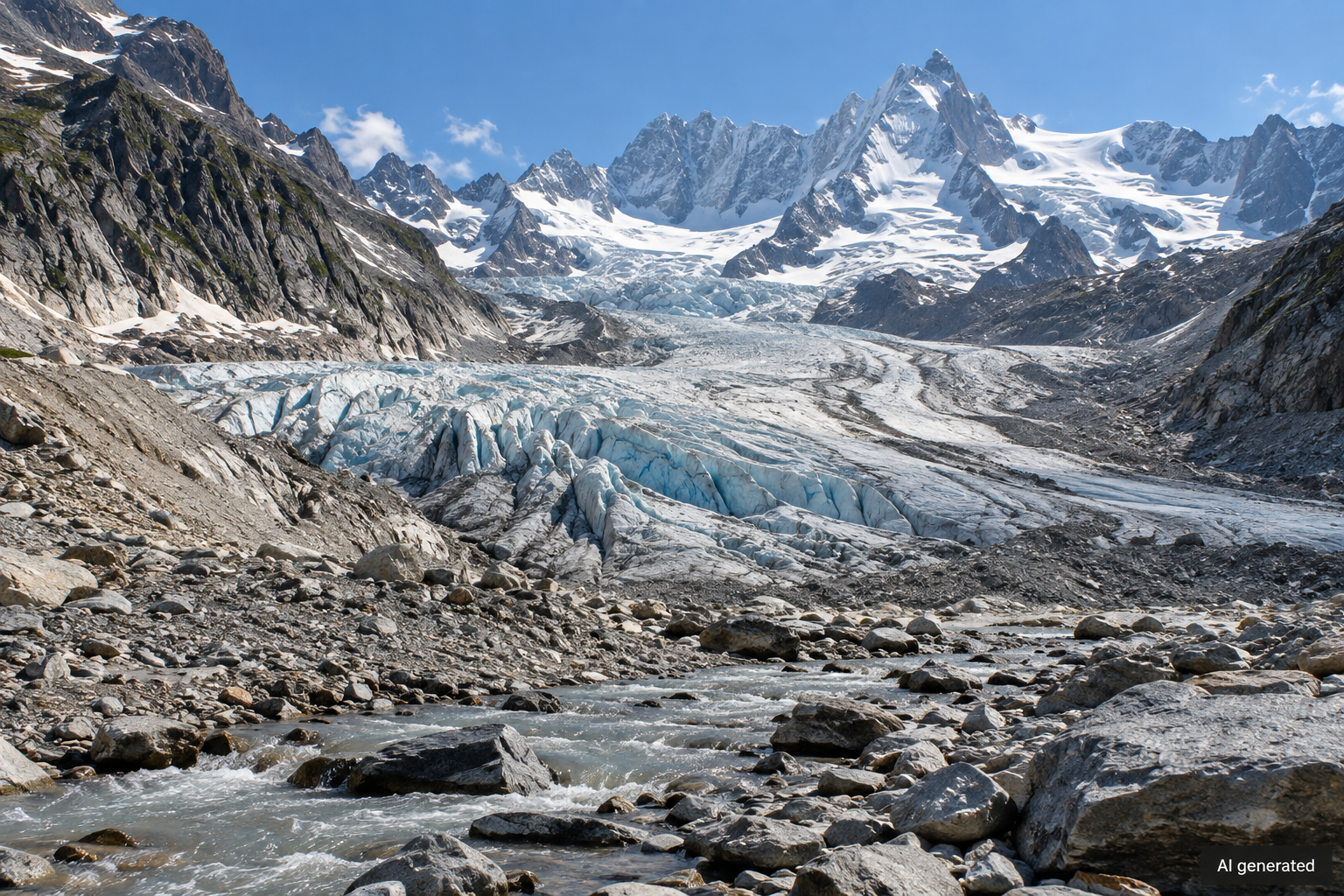
Photographs from the Mer de Glace give a physical shape to the story of a changing summer. The Associated Press describes a shrinking glacier above Chamonix after exceptional heat, with thawing Alpine permafrost also contributing to rockfall concerns.
A photograph makes change visible, but it cannot on its own establish a rate of loss. That requires measurements taken with a consistent method over time. WHIF is not deriving a new estimate of glacier retreat from the images or claiming that an archive landscape shows current conditions.
Reading a landscape carefully
The Mer de Glace lies on the northern side of the Mont Blanc massif, above the Chamonix valley. Its geographical setting is useful context: a glacier belongs to a connected mountain landscape, not just the viewpoint from which a visitor happens to see it.
The European Environment Agency’s climate-risk assessment considers risks to ecosystems and infrastructure across Europe. That wider frame helps explain why a change in the mountains can be discussed as more than scenery. It does not provide a site-specific forecast for this glacier.
Our reading of the combined material is that tourism coverage needs two clocks. One follows the long-term transformation of a place; the other follows conditions on the day of a visit. A description that is accurate historically may still be unsuitable as current route information.
A changing place needs current information
Anyone planning a mountain excursion should therefore use up-to-date information from local operators and qualified mountain services. An article, an old photograph or a familiar itinerary is not confirmation that a route is open or appropriate for a particular group.
The glacier’s name promises a sea of ice, but its public meaning is changing as people look at what remains. The task for reporting is to connect that experience with measured evidence, without turning a powerful image into a claim more precise than the sources can support.
Sources & context
Reporting and reference material used for this article. Context sources do not independently confirm every news claim.
- Associated Press ↗Reporting on this story
- Mer de Glace — geographical reference ↗Background location and landscape; not current measurements
- European Environment Agency — European Climate Risk Assessment ↗European risk assessment, published March 2024; background
Written for WHIF from the linked material. This article does not claim on-the-ground reporting. Our editorial standards.