Fontainebleau moves from reopening to the long work of regeneration
Most of the forest is accessible again after July's fires, but closed sectors and fragile soils remain. The next decisions concern safety, natural recovery and the kind of woodland that can withstand a hotter climate.
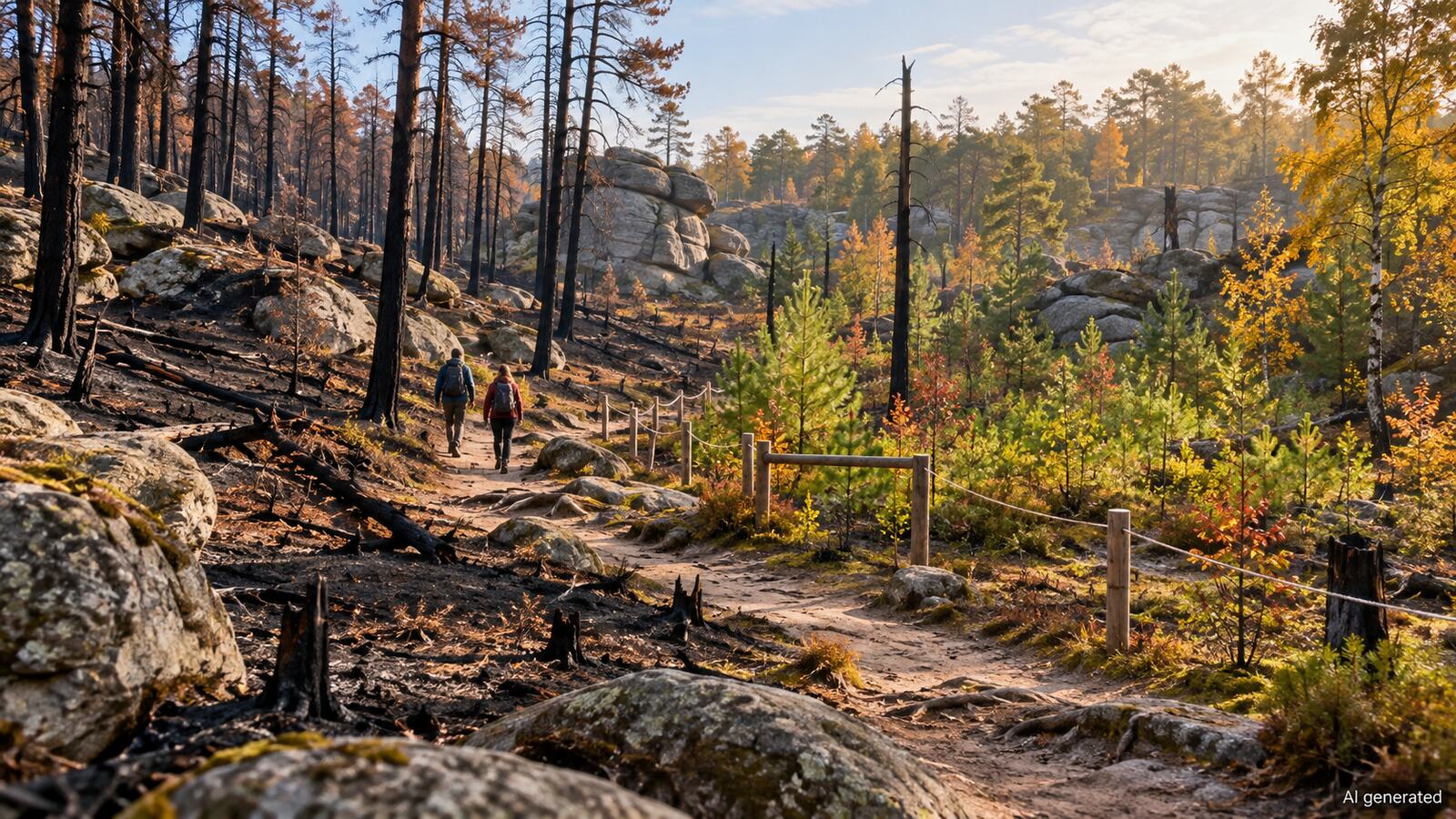
Fontainebleau's post-fire story has moved beyond emergency response. The National Forestry Office says about 20,000 hectares, roughly 90% of the massif, are accessible again, while barriers and signs protect sectors that remain dangerous or ecologically fragile. For visitors, reopening means following the current map and staying on authorised roads, paths and trails.
The July fires affected about 2,000 hectares in the Fontainebleau and Trois-Pignons state forests. AP reported evacuations and disruption to trains and the A6 motorway during the emergency. The ONF later declared the fire extinguished on 29 August after crews continued flooding hot spots in combustible forest soil.
Open paths do not mean a recovered forest
Safety came first. The ONF describes extensive work to identify and remove heat-damaged trees near the A6 and departmental roads before routes could reopen. That intervention protects traffic and walkers, but it is not the same as ecological recovery. Burned soils, weakened trunks and disturbed habitats will require observation over years.
Some popular landscapes remain unavailable. Le Monde reported that much of Trois-Pignons, including sections used by runners and climbers, is expected to stay closed until September 2027. The article also described uncertainty about impacts on insects, reptiles and mammals. Its interviews show why pressure to reopen must be balanced against safety and habitat protection.
The ONF's regeneration approach starts by observing which vegetation returns naturally before deciding where planting or other intervention is justified. Natural recovery can preserve locally adapted species and soil processes, while severely damaged or invasive-dominated areas may need active management. The right treatment may differ from one parcel to another.
Regeneration is also a climate decision
That choice is also about future climate. Naturalists and residents quoted by Le Monde argued for a more diverse forest rather than simply recreating pine-heavy stands vulnerable to drought and fire. Their proposals are viewpoints, not an adopted ONF plan, but they identify the central question: restoration must prepare for conditions that may differ from those before July.
Visitors can help by treating closure signs as part of the recovery work. The open area is substantial, but a figure of 90% should not be read as 90% ecological recovery. Fontainebleau's roads and many paths reopened within weeks; rebuilding soils, habitat and resilient tree cover will take far longer.
Sources & context
Reporting and reference material used for this article. Context sources do not independently confirm every news claim.
- National Forestry Office: stages of regeneration after the fire ↗Primary source: reopening, safety work and regeneration approach
- National Forestry Office: map of open and closed sectors ↗Primary visitor guidance: accessible area, closures and fire footprint
- Associated Press: Fontainebleau fire and evacuations ↗Independent reporting: July emergency, transport disruption and regional context, 13 July
- Le Monde: artists and naturalists discuss Fontainebleau's rebirth ↗Context and viewpoints: closures, biodiversity concerns and proposals for a mixed forest, 26 October
Written for WHIF from the linked material. This article does not claim on-the-ground reporting. Our editorial standards.