Student protest shifts towards universities after a limited school restart
Youth unions called for wider university and school blockades on 3 November, after official and union counts gave sharply different pictures of Monday's disruption.
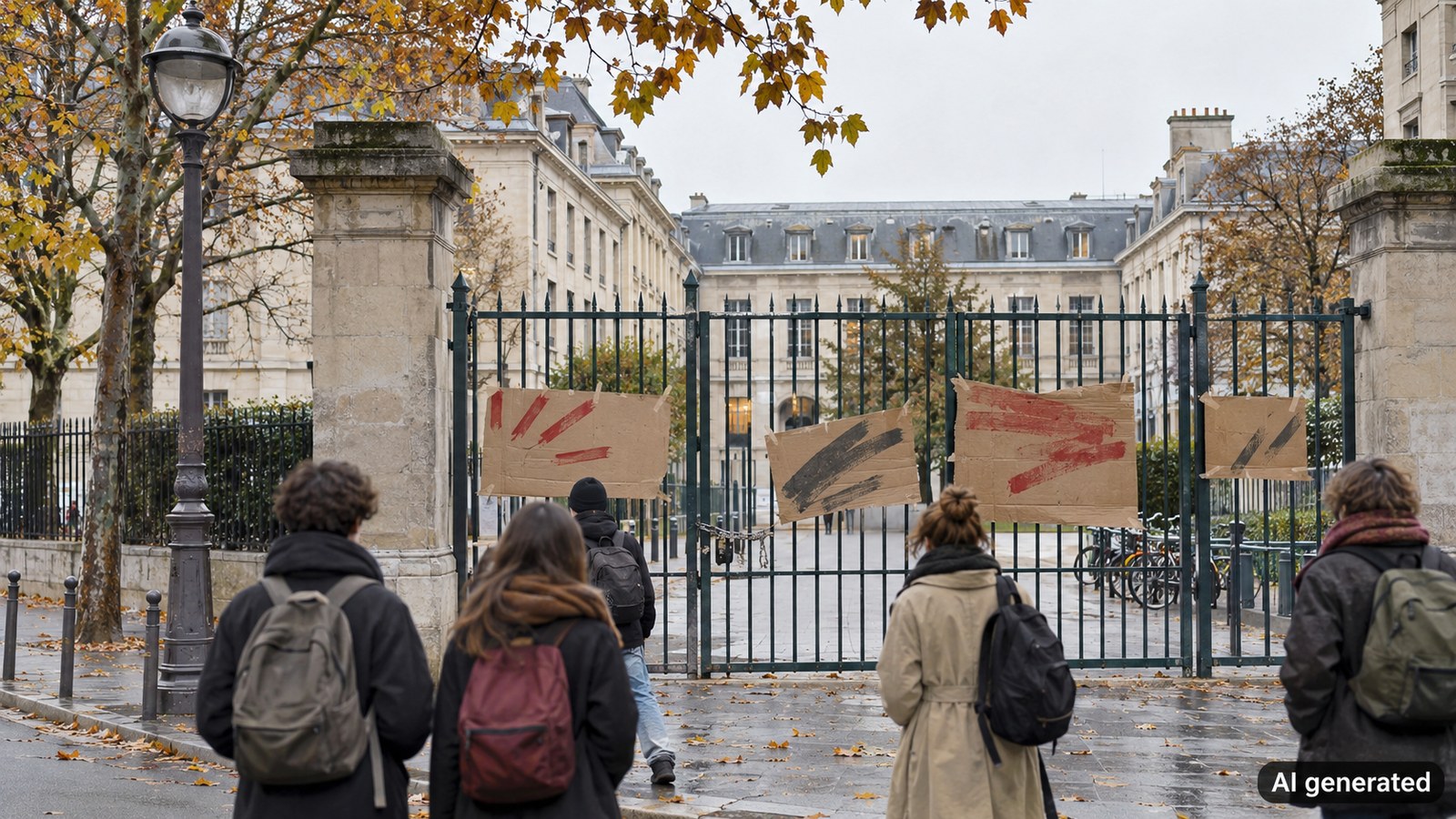
France's student protest entered a new test on Tuesday 3 November as university and secondary-school groups called for broader blockades. The call followed a first post-holiday day that produced real but limited disruption by the government's count. At publication time, Tuesday's national outcome was not yet available, so announced actions should not be mistaken for completed closures.
The Education Ministry counted 41 blocked secondary schools at 9:30 on Monday, slightly more than 1 percent of roughly 3,700 establishments. The Union syndicale lycéenne said it had counted about 150, while another youth representative later cited a higher figure. Those totals use different methods and were not independently reconciled.
A wider but uneven higher-education footprint
Higher education showed a wider but uneven footprint. Higher Education Minister Philippe Baptiste said around 15 percent of institutions experienced some disruption on Monday, ranging from a temporarily blocked building to laboratories unable to operate normally. That measure does not mean 15 percent of universities were fully closed.
Tuesday's call was deliberately broader. UNEF described the planned university action as a black day, while other student and school groups urged participants to build towards the interprofessional mobilisation scheduled for Thursday 5 November. Le Parisien reported that some Monday gatherings were used to organise the next stage rather than to close entire campuses.
A march route becomes a legal test
A separate dispute concerned the proposed Paris march. Reporting on a police order said authorities rejected the organisers' preferred central route and proposed an eastern Paris alternative, citing operational pressure and previous disorder. Interfac Île-de-France said it would challenge the restriction before the administrative court. A legal challenge is not the same as a court ruling.
The renewed action comes after government commitments on staffing, class sizes, higher-education places and the planned replacement of Parcoursup. Youth organisations say those measures remain insufficient. The government argues that continuity of teaching must be protected after weeks of disruption. The competing claims are political positions, not evidence of Tuesday's turnout.
What can be measured next
The useful comparison will come from confirmed campus access, official totals, union counts with disclosed methods and any judicial decision on the Paris route. For now, the material development since Monday is a shift from scattered school blockades towards a coordinated university test, with the national scale still to be established.
Sources & context
Reporting and reference material used for this article. Context sources do not independently confirm every news claim.
- TF1 Info ↗Live reporting, published 3 November 2026 at 06:00: official and union school counts, higher-education disruption and Tuesday's calls.
- Le Parisien ↗Independent live reporting, updated 3 November 2026 at 06:42: mobilisation sequence and organisers' stated objectives.
- AFP via TV5MONDE ↗Independent context, updated 2 November 2026: youth-organisation calls and the week-long timetable.
- Le Journal de la France ↗Reporting, published 2 November 2026: police route decision, proposed alternative and announced court challenge.
Written for WHIF from the linked material. This article does not claim on-the-ground reporting. Our editorial standards.