France deploys 70,000 police for Halloween protests
A third Saturday of demonstrations brings a larger perimeter of restrictions, a high-risk warning and a renewed test of whether policing can protect both public safety and the right to protest.
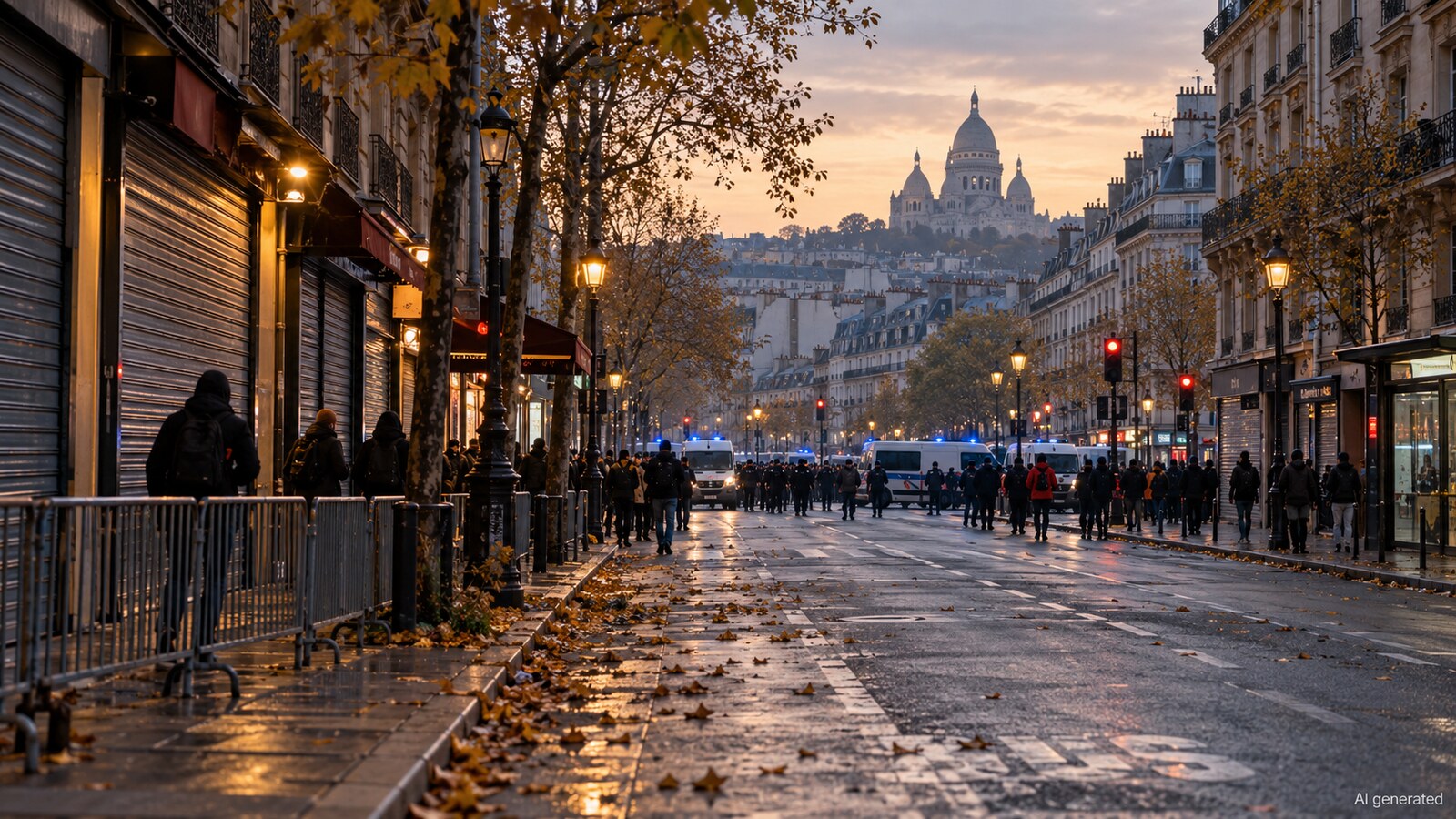
France entered Saturday 31 October with 70,000 police and gendarmes mobilised for a third consecutive weekend of nationwide protests. The demonstrations coincide with Halloween, and authorities said masks could complicate identification if peaceful marches were infiltrated by people intent on violence. This article describes preparations, not an outcome that had not yet occurred at publication time.
The immediate reference point is 17 October, when riots and looting accompanied much larger demonstrations, followed by a calmer but still heavily policed mobilisation on 24 October. The Interior Ministry counted 410,000 participants at 289 actions on that second Saturday, with 1,314 arrests in its provisional overnight tally. Those official figures remain the government's account and should be read as such.
A tighter Paris perimeter
Paris is the most visible test. Associated Press reported that the march was pushed towards outer boulevards, while access restrictions covered locations damaged earlier in the month. An unaccompanied-minors curfew was also imposed around the Champs-Élysées from 9pm, after a court had suspended an earlier, broader curfew as an unlawful restriction on freedom of movement.
Transport and retail disruption are part of the story before any confrontation. AFP reported that more than 40 Paris Métro stations would close and that some tram services would be affected. Shops again protected windows and entrances, reflecting the scale of losses claimed after 17 October and the difficulty of separating precaution from prediction.
A movement with several constituencies
The movement itself is broader than one organisation. Reporting by Reuters, AP and AFP describes high-school and university students, trade unions and renewed Yellow Vest participation, with grievances spanning school conditions, purchasing power, inequality, public services and civil liberties. That diversity makes turnout easier to widen and political ownership harder to define.
The security response therefore faces two tests at once. Authorities want to stop looting, arson and attacks, while courts and civil-liberties advocates continue to examine restrictions on movement and assembly. A mask worn for Halloween is not evidence of criminal intent, and powers to restrict face coverings still require a public-order justification.
What can be said before the marches
The most important verified facts on Saturday morning are the deployment, restrictions and declared marches. Crowd size, arrests, injuries and damage can only be assessed after official and independent reporting is available. WHIF will treat later figures as a separate update rather than writing an expected outcome into the record.
Sources & context
Reporting and reference material used for this article. Context sources do not independently confirm every news claim.
- Reuters ↗Reporting, published 31 October 2026: national deployment, government risk assessment and protest context.
- Associated Press ↗Independent reporting, published 31 October 2026: Paris restrictions, curfew litigation and European context.
- Agence France-Presse ↗Independent reporting, published 31 October 2026: transport disruption, security preparations and movement demands.
- French Interior Ministry ↗Primary context, published 25 October 2026: official account of the previous mobilisation; figures are attributed to the ministry.
Written for WHIF from the linked material. This article does not claim on-the-ground reporting. Our editorial standards.