French projects enter Europe’s new critical-materials push
Rare-earth separation, lithium, battery materials and recycling projects in France won EU strategic status, which can accelerate permits but does not guarantee financing.
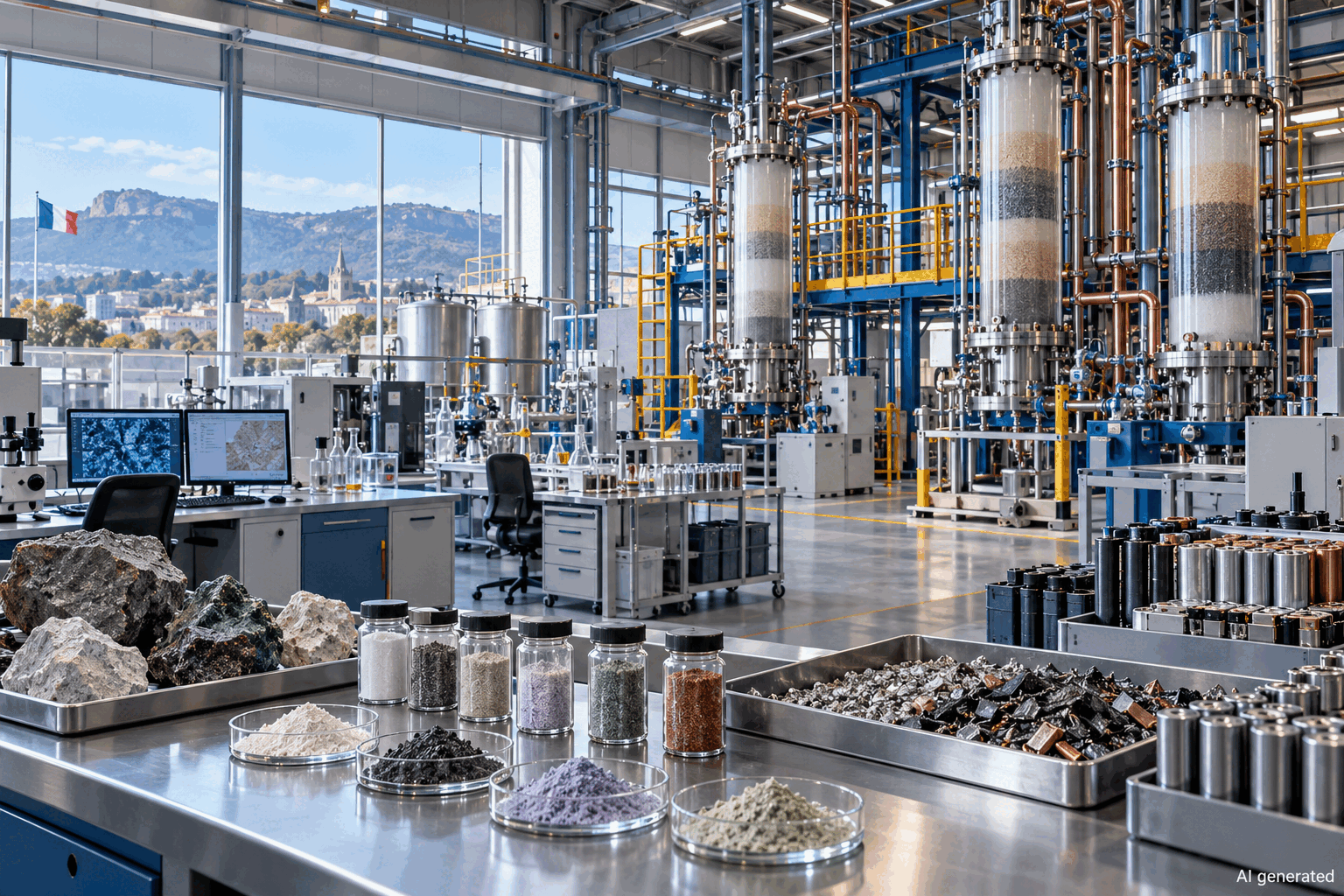
The European Commission designated 46 new strategic critical-raw-material projects on 9 October, including several promoted from France. The official decision lists projects involving rare-earth separation in Lyon, lithium development near Haguenau, battery materials in Bordeaux and Dunkirk, and specialised metallurgy. The list broadens Europe’s industrial response to supply risks beyond mining alone.
Strategic status has practical value, but it is not an EU cheque. Reuters reported that selected projects can benefit from faster permitting and assistance in seeking public and private finance. The Commission says the 46 projects across 16 member states would collectively require about €21.1 billion in capital investment.
The French list spans processing, batteries and metallurgy
The French entries cover different points in the chain. Rhodia Operations’ BREES project concerns rare-earth separation. The official annex also names EMME in Bordeaux, Lithium de France, Aubert & Duval’s LUERN project and NEOMAT-PCAM in Dunkirk. Their inclusion illustrates why security of supply depends on processing, refining and recycling as well as extraction.
The policy goal is to reduce dangerous concentration, especially where China dominates materials or processing used in batteries, renewable energy, defence and electronics. Under the 2024 Critical Raw Materials Act, the EU aims by 2030 to extract 10 per cent, process 40 per cent and recycle 25 per cent of its annual strategic-material needs.
Faster permits still require environmental evidence
Designation does not remove the need for environmental scrutiny or local consent. The Commission says applications were assessed for technical feasibility, sustainable implementation, cross-border benefits and contribution to supply security. Faster decisions should mean a clearer timetable, not weaker evidence about water, waste, energy use or community impacts.
Financing is the next risk. Reuters noted that progress among projects selected in the previous round had been slow and that developers warned some could fail without urgent capital. The Guardian likewise reported concern that support mechanisms may not close every investment gap, even as Brussels seeks to accelerate supply before 2030.
For France, the new status is best read as a portfolio of industrial options. Success will require permits, buyers, engineering and money to arrive together. The meaningful scoreboard is not how many projects appear in a Commission annex, but how many reach operation with transparent environmental controls and produce materials that European manufacturers actually use.
Sources & context
Reporting and reference material used for this article. Context sources do not independently confirm every news claim.
- European Commission decision ↗Primary legal source, 9 October: selection criteria and complete list of 46 strategic projects and promoters.
- European Commission ↗Primary policy source, 9 October: programme scope, member-state coverage and investment estimate.
- Reuters ↗Independent reporting, 9 October: financing limits, permitting benefits and 2030 supply targets.
- The Guardian ↗Independent reporting, 9 October: geopolitical context and questions over project funding.
Written for WHIF from the linked material. This article does not claim on-the-ground reporting. Our editorial standards.