Insee maps the economic weight of France's craft sector
A new study counts 1.1 million craft establishments and finds a strong rural presence alongside lower pay, uneven productivity and an ageing owner base.
France had 1.1 million establishments whose principal activity was a craft trade in 2023, according to an Insee study published on 19 November. Together they generated 146.5 billion euros in value, equivalent to 5.2 percent of national gross domestic product, and supported 3.3 million jobs.
Insee examines a narrower group in greater detail: 744,000 craft establishments with no more than ten full-time-equivalent employees, excluding micro-entrepreneurs. That group employed 1.8 million people and generated 83 billion euros, representing 28 percent of employment among market establishments of comparable size.
Rural density reflects everyday local demand
The sector is especially dense in rural and tourist areas because many trades serve resident and seasonal demand locally. Food, construction, personal services and small-scale manufacturing all fall within the definition, making the category more diverse than a single image of traditional hand production suggests.
Construction accounts for 39 percent of craft employment and 45 percent of the value generated in the detailed group. Manufacturing has the highest value per job at 60,000 euros, compared with an average of 45,800 euros across the craft sector measured.
Pay and gender gaps sit behind the headline total
Labour conditions reveal important gaps. Employees received an average net annual wage of 18,500 euros, about 4,000 euros below the average for market establishments of similar size. Women represented one third of employees overall and only 16 percent in construction.
Succession is another issue: 30.1 percent of self-employed craft workers were over 55. A separate MAAF and Institut Supérieur des Métiers barometer tracks strong business creation, but registrations and the stock of active establishments measure different things and should not be presented as one trend.
An ageing owner base raises succession questions
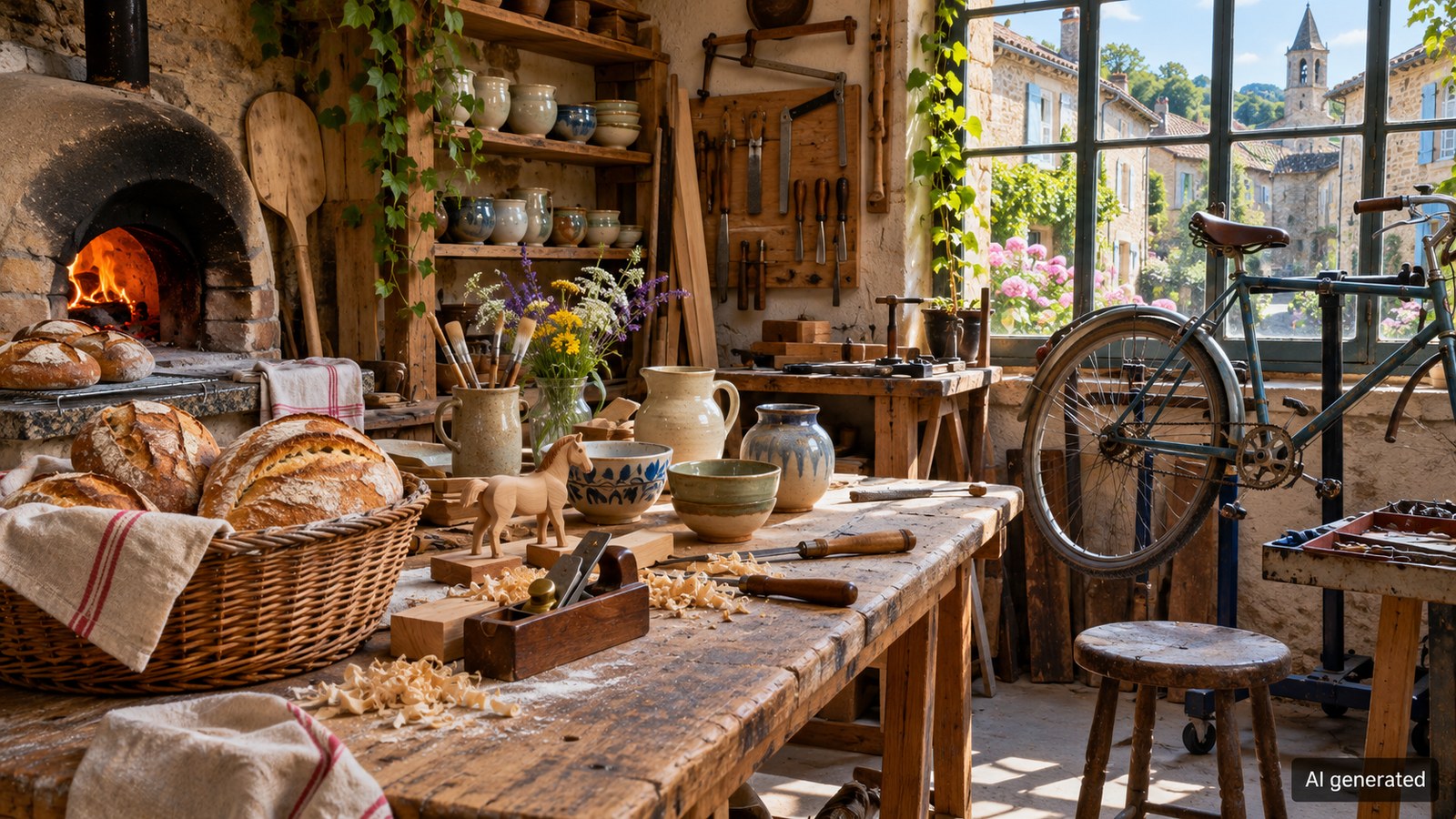
The study shows a sector that is economically substantial and locally important, but also fragmented by activity, pay and territory. The accompanying image is an invented mixed craft workshop, not a photograph of a surveyed establishment, worker or named village.
Sources & context
Reporting and reference material used for this article. Context sources do not independently confirm every news claim.
- Insee ↗Primary statistical study, published 19 November 2026: establishments, employment, value, pay, sector and geographic structure.
- Économie Matin ↗Independent reporting, published 19 November 2026: corroboration and summary of the national economic totals.
- Banque des Territoires, MAAF and Institut Supérieur des Métiers ↗Contextual industry barometer, published in October 2026: separate evidence on craft-business creation and sector composition.
Written for WHIF from the linked material. This article does not claim on-the-ground reporting. Our editorial standards.