France gives critical sites new counter-drone powers, with limits
A law now permits approved operators to detect, jam or intercept drones. Training, state oversight and liability remain central to deployment.
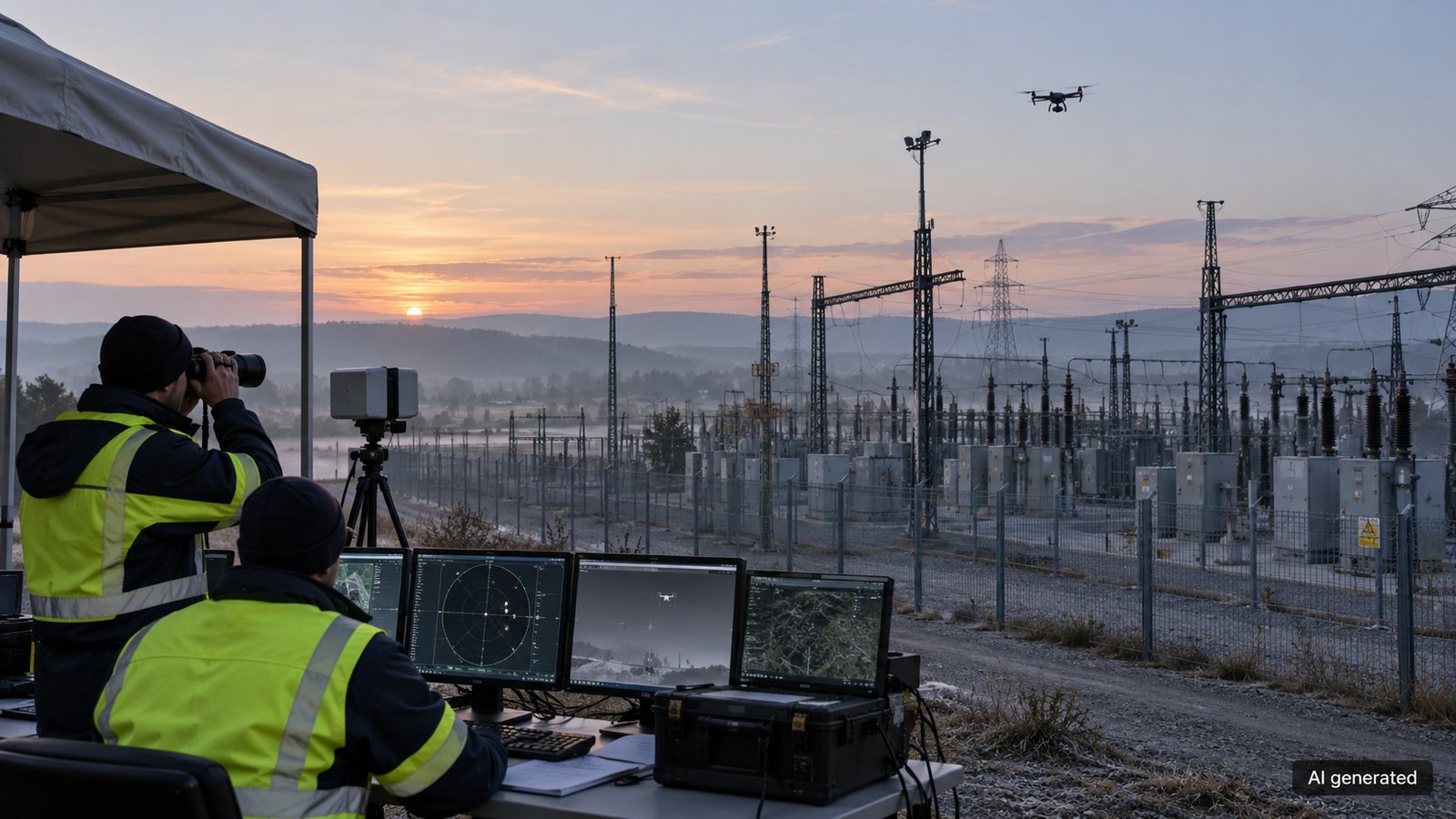
France is moving counter-drone protection beyond the armed forces and police. Reuters reported on 21 October that an August law allows approved operators of critical infrastructure and their contractors to detect, jam and intercept drones near designated facilities. The policy responds to concern that widely dispersed power, transport and military sites cannot always wait for a specialist state team.
Testing at Brétigny-sur-Orge shows the industrial part of the plan. Systematic Paris-Region told Reuters that evaluations begun this summer had catalogued three systems integrators and 17 counter-drone systems. France aims to equip an expanded list of sensitive sites by 2027, according to a senior official cited anonymously by Reuters. That timetable is reported policy, not proof that every site is already protected.
A power under public control
The legal authority is narrower than a general licence to shoot down aircraft. The Conseil d'État's published opinion says implementing rules must cover authorisation, training, oversight, acquisition and storage. It limits users to authorised private-security organisations and specifically designated, trained agents, while also allowing relevant SNCF and RATP security staff within the defined scope.
State control remains explicit. The opinion says the local prefect and competent judicial police officer must be informed without delay after a system is used. It also notes that a good-faith drone owner whose property is damaged must retain ordinary routes to compensation. Those safeguards matter because an intercepted aircraft can itself injure people or damage property.
Technology is only one layer
The new power does not remove the need to identify a drone, judge intent and choose a proportionate response. Electronic jamming may be suitable in one environment and unsafe in another. Interceptor drones add further operational and liability questions. Reuters found that technology is developing faster than common European rules on who may authorise a response.
For operators, resilience still matters alongside interception. A successful defence system cannot eliminate every intrusion, false alarm or outage. Procurement therefore needs to be assessed with recovery planning, staff training and coordination with public authorities, not as a stand-alone technology purchase.
Source access note: Reuters supplied current reporting from Brétigny and interviews across Europe. The Conseil d'État opinion and CNAPS guidance were consulted as primary legal context. The full Légifrance law page was indexed but did not open reliably, so this article does not attempt a clause-by-clause restatement of the statute.
Sources & context
Reporting and reference material used for this article. Context sources do not independently confirm every news claim.
- Reuters: Europe weighs wider counter-drone powers ↗Reporting: French testing programme, operator concerns and European comparison, 21 October
- Conseil d'État: opinion on the military programming update ↗Primary legal context: authorisation, oversight, notification and compensation safeguards
- CNAPS: private-security changes for autumn 2026 ↗Primary implementation context: neutralisation activity opened to private-security agents
- Légifrance: Law 2026-791 of 16 August 2026 ↗Primary statute: indexed text consulted; direct page unavailable during this edition
Written for WHIF from the linked material. This article does not claim on-the-ground reporting. Our editorial standards.