France's fifth protest Saturday draws fewer people and a new firework ban
Official turnout fell to 106,000, organisers claimed 200,000, and a national decree now restricts sales and use of common pyrotechnics through 27 November.
France's fifth Saturday of demonstrations over living costs and other demands drew fewer people than the previous weekend. The Interior Ministry counted 106,000 participants at 137 actions on 14 November, including 24,000 in Paris. It had counted 146,000 nationwide and 46,000 in the capital a week earlier.
The youth inter-union coalition gave a much higher estimate of 200,000 nationwide, including nearly 100,000 in Paris, according to Reuters. The gap should be preserved rather than averaged: police and organisers use different methods and have competing institutional interests.
A smaller crowd with several causes
Le Monde described heterogeneous but determined processions in Paris and Lyon, reflecting a mobilisation that joins living-cost anger with youth, education and policing demands. The national totals show a smaller day, but they do not resolve which demands have durable support or predict participation in the next announced mobilisation.
Authorities reported incidents in several cities. The Interior Ministry said 219 people were arrested and 10 police officers were lightly injured. These are official figures, not an independent census of every confrontation or injury, and they should not be used to describe all demonstrators as violent.
A temporary nationwide pyrotechnics restriction
A decree published on 15 November adds a temporary national restriction on the sale and use of category F2 and F3 fireworks through 27 November. The government linked it to pyrotechnics used during protests and around schools. Licensed professionals and public authorities retain exemptions, while category F4 devices remain reserved for professional pyrotechnicians.
The decree changes access to common fireworks, but their use on public roads was already tightly restricted. Its stated purpose is to reduce serious public-order risks during current school and university blockades and demonstrations. The measure is time-limited, and its practical enforcement will depend on retailers, online sales controls and local policing.
Turnout does not settle the dispute
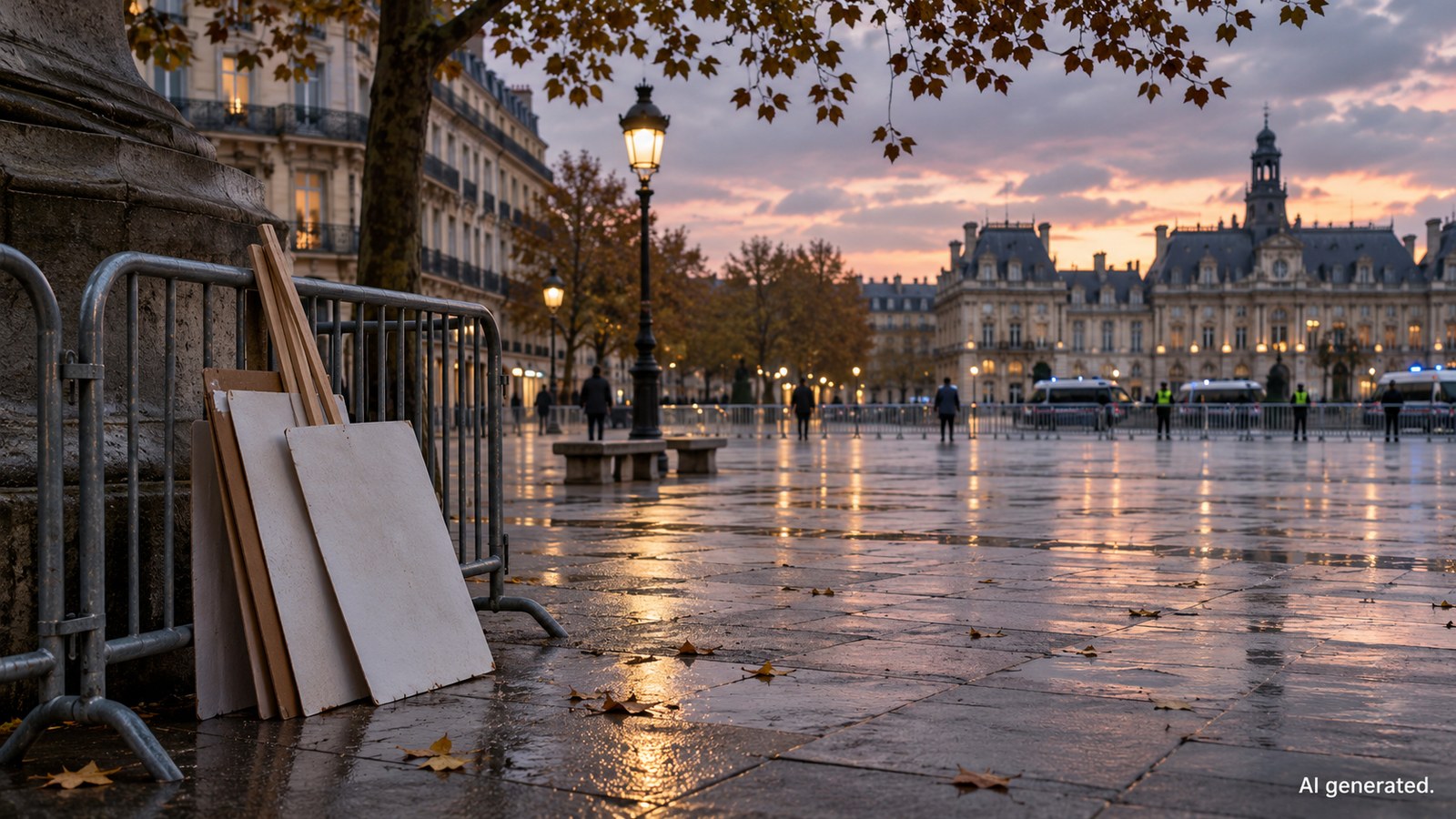
The next test is whether Tuesday's public-sector mobilisation broadens or fragments the movement. Saturday's lower official count is a real change, not proof that the wider dispute is over. The accompanying image is an invented, post-demonstration city scene, not a photograph of the 14 November marches, participants or police operation.
Sources & context
Reporting and reference material used for this article. Context sources do not independently confirm every news claim.
- Reuters via Boursorama ↗Independent reporting, 14 November 2026: official and organiser turnout estimates, comparison with earlier Saturdays and reported incidents.
- French Interior Ministry ↗Primary official account: action count, police turnout series, arrests and reported police injuries.
- Le Monde ↗Independent on-the-ground reporting from Paris and Lyon: composition, demands and atmosphere in the processions.
- Decree 2026-1047 ↗Primary legal reference linked to the official text: pyrotechnics categories, national scope, exemptions and 27 November end date.
Written for WHIF from the linked material. This article does not claim on-the-ground reporting. Our editorial standards.